
The Challenge
The source file contained 9,527 references with uneven data quality, incomplete image coverage and product rows that could not all be resolved from a single identifier or source.
A large supplier catalog contained thousands of product references with incomplete image coverage and uneven product signals. AIKIVORS applied a structured multi-source recovery workflow, parallel processing and quality control to turn the catalog into a more usable operational dataset.
The objective was not simply to find more images. The project required reliable correspondence between supplier rows, product identifiers and recovered assets, while keeping difficult records visible for additional processing.
The source file contained 9,527 references with uneven data quality, incomplete image coverage and product rows that could not all be resolved from a single identifier or source.
Product signals were evaluated through several recovery routes: direct identifier matching, multi-source refinement and targeted processing for valid or missing EAN situations, supported by six parallel workers.
7,479 references were associated with product images and structured into the working catalog. 2,048 references remained without image and stayed visible for further recovery rather than being hidden by an artificial completion rate.
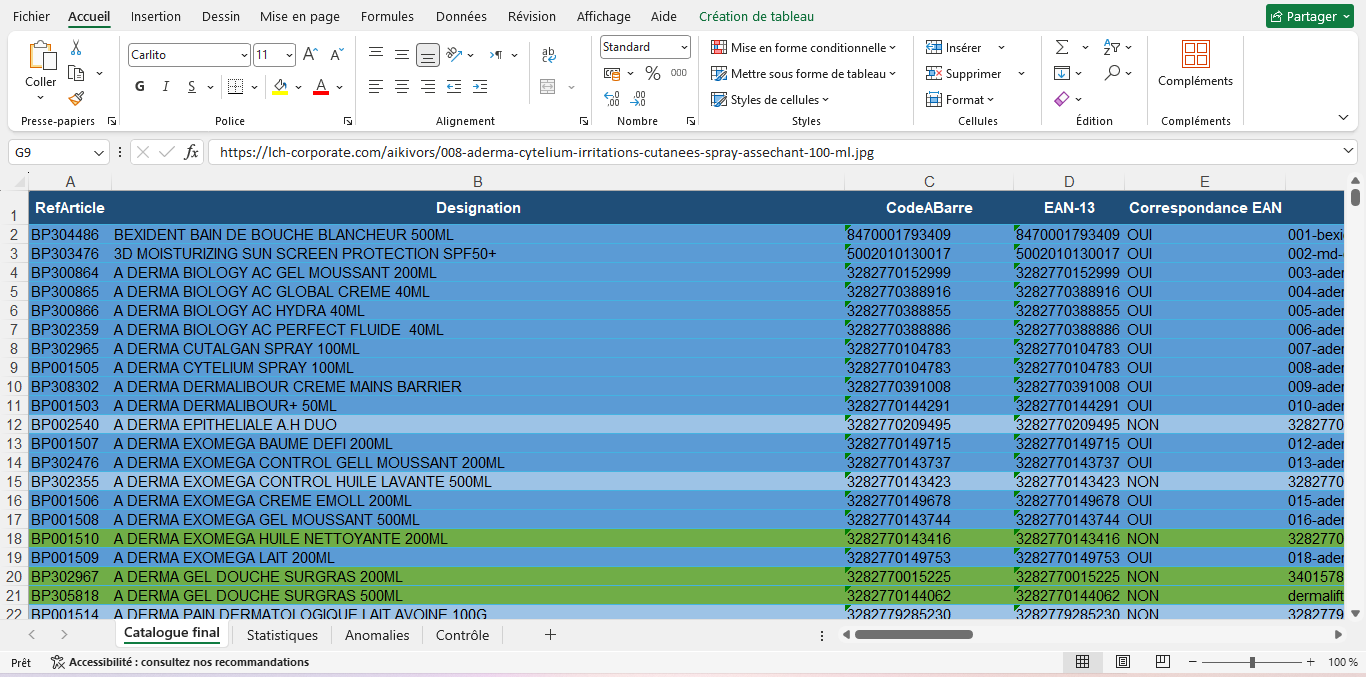
Existing references, EAN values, designations and row-level metadata became the basis for recovery. Instead of replacing the source data, the workflow used it to guide matching, preserve traceability and determine which recovery route was appropriate for each product.
These figures reflect the recorded project state. They are presented without extrapolating a completion rate beyond the results actually obtained.
Total number of product rows in the working catalog.
Rows associated with a recovered or validated product image.
Share of the source catalog represented by the 7,479 image-backed references.
Rows retained for further recovery, equal to 21.50% of the source catalog.
The official M8 baseline reconciliation verifies the historical consolidated workbook against the immutable 9,527-row source. Source rows are preserved exactly, row-for-row and in order.
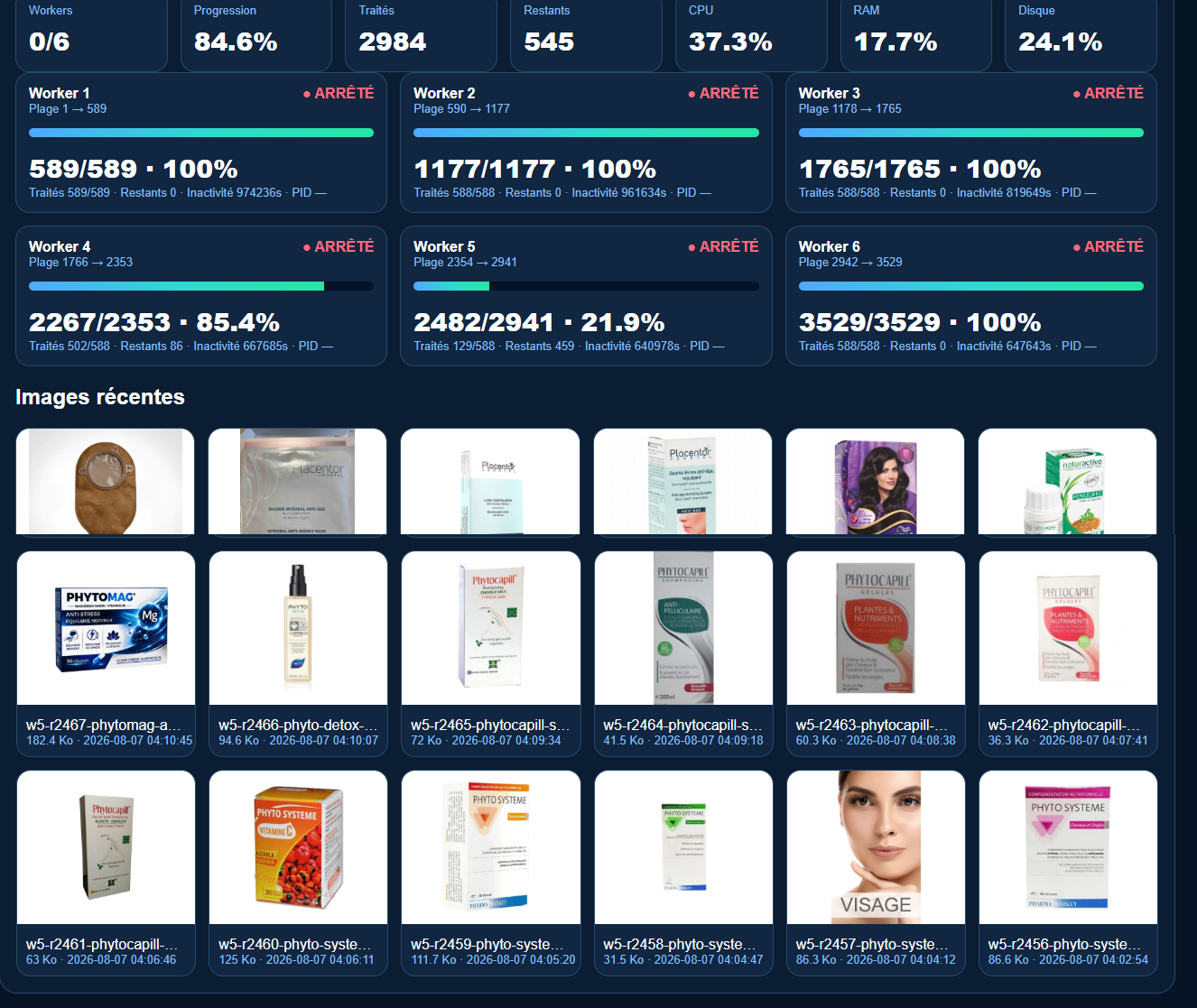
The catalog was divided into controlled processing ranges so several workers could operate in parallel. The objective was not speed alone: output consistency, traceability and the ability to revisit unresolved product rows remained part of the operating model.
High-volume recovery still requires judgment around ambiguous references, unsuitable images and the practical usefulness of the final data structure.
Recovered assets and difficult matches can be reviewed so obvious advertising visuals, logos, irrelevant images or weak product correspondence do not silently enter the final catalog.
Unresolved product rows can be separated for another pass, different sources or manual attention rather than being treated as failures hidden inside a single completion statistic.
The official immutable source contains 9,527 non-empty product rows.
7,479 references were associated with an image in the recorded project state, representing 78.50% of the 9,527 source references.
Supplier product rows do not all contain the same quality of identifiers or designations. Direct EAN matching can resolve some references, while others require multi-source comparison or targeted recovery methods.
2,048 rows remained without either a local image filename or a remote image URL in the audited historical final workbook. Keeping these rows visible makes it possible to revisit them with additional sources or another recovery pass.
Yes. The free 25-SKU audit is designed to test recoverability, matching quality and output structure on a representative sample before moving to a larger catalog.
Send a representative product sample and evaluate the available recovery signals, image potential and output structure before committing to a larger catalog project.